

Peak Nano & E&P Technologies Partnership
Engineered to Scale, Qualified for Deployment
As fusion scales toward repetitive operation, reliable pulsed power becomes mission-critical. Capacitors sit at the center of that challenge.
Peak Nano and E&P Technologies have built a new model for pulsed power innovation, pairing advanced dielectric materials with precision manufacturing.
E&P’s next-generation high-energy-density capacitors, powered by Peak Nano’s NanoPlex™ HDC dielectric film platform, accelerate development and strengthen the domestic industrial base for high-performance energy systems.
DC Data Centers
As data centers shift to 800 VDC, film capacitors become the critical enabling component at every stage of the power chain. NanoPlex™ LDF and HDC deliver the voltage headroom, thermal resilience, and service life that 800 VDC AI factories demand.
Why Data Centers Are Moving from AC to DC
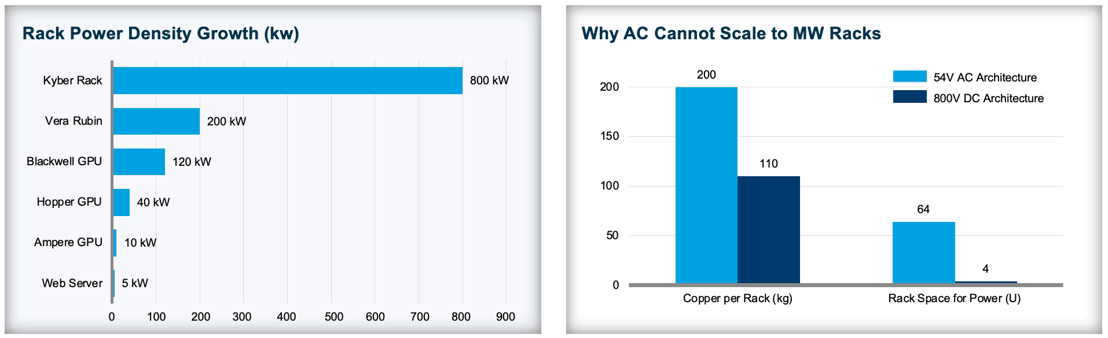
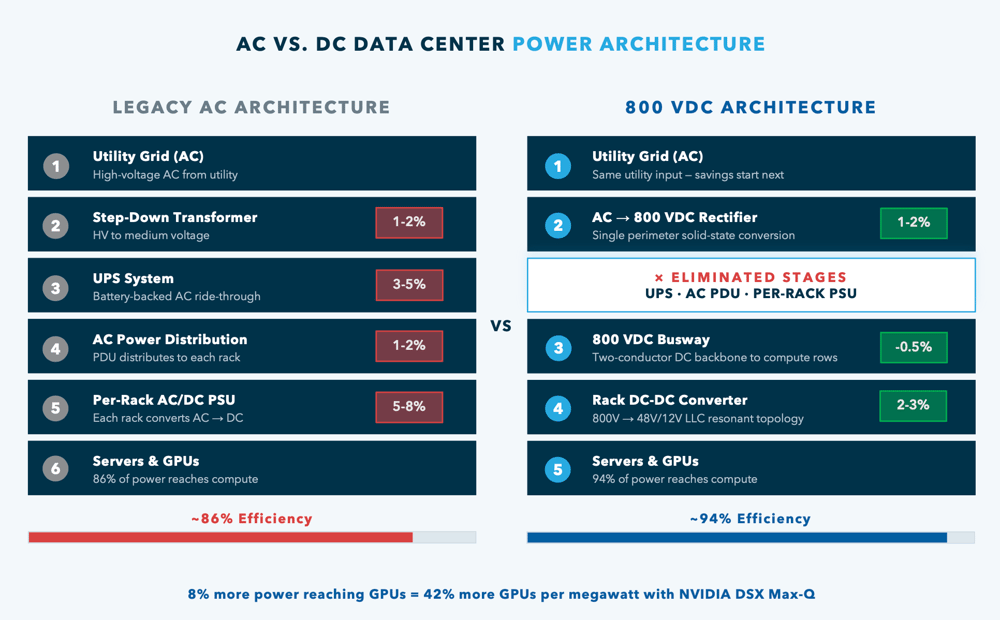
GPU rack power density has increased 100× in a decade. At 600 kW to 1 MW per rack, the traditional AC power chain, with its five conversion stages and 12–15% energy losses, cannot scale. The 800 VDC architecture eliminates three conversion stages, cuts losses to 5–7%, and delivers more GPUs per megawatt.
DC Data Center Performance Advantages
At the gigawatt scale, a 1 GW AI factory on 800 VDC delivers the compute capacity of a 1.42 GW legacy AC facility, avoiding the need to build, power, and cool 420 MW of additional infrastructure.
Up to 5%
End-to-End Efficiency Improvement
vs. legacy AC
Up to 70%
Lower Maintenance Cost
Fewer conversion stages = fewer failure modes
Up to 30%
Lower Total Cost of Ownership
Lifetime cost significantly reduced
Up to 45%
Lower Copper Requirement
85% more power per conductor
Up to 64
Rack Spaces Reclaimed for Compute
By eliminating power shelves
More GPUs per Megawatt
800 VDC efficiency improvements translate directly into GPU deployment density. At 86% efficiency (legacy AC), ~14% of every megawatt is lost to conversion overhead. At 94% (800 VDC), losses drop to 6%.
Combined with NVIDIA’s DSX Max-Q dynamic power provisioning, which delivers ~30% more GPU density per MW by eliminating idle waste at millisecond granularity, the total improvement reaches 42% more GPUs per megawatt.
Capacitors and Converters in the 800 VDC Power Chain
The 800 VDC architecture creates four new converter topologies, each with distinct voltage, switching frequency, and capacitor requirements.
| AC-DC Rectifier (Perimeter) | DC-DC Converter (Rack-Level) | Bidirectional DC-DC (Energy Storage) | Point-of-Load (Board-Level) | |
|---|---|---|---|---|
| VOLTAGE | 13.8kV AC → 800 VDC | 800 VDC → 48V/12V | 800 VDC supercap/BESS | 48V 12V → 0.8-1.2V |
| POWER | 100 kW-1 MW modules | 30-100 kW per rack | 10-100 kW per rack | 1-10 kW per tray |
| TOPOLOGY | PFC rectifier or MVSST | LLC resonant SiC/GaN | Dual active bridge | Multi-phase buck |
| CAP TYPE |
MPPF AC filter DC bus film |
LLC resonant Snubber film |
DC link film High-voltage |
MLCC + polymer electrolytic |
| NANOPLEX | HDC | LDF | LDF + HDC | N/A |
NanoPlex™ Capacitors: Top 5 Use Cases in DC Data Centers
Film capacitors serve distinct, mission-critical functions at each stage of the 800 VDC power chain. Capacitors are essential for rack-level power smoothing. A 100 MW DC data center contains 130,000 to 220,000 pounds of capacitors.
NanoPlex Grade: LDF & HDC
The backbone energy buffer at every major conversion stage. These capacitors sit on the high-voltage DC bus inside rack power units and perimeter rectifiers, smoothing the rectified voltage and absorbing the high-frequency ripple current generated by SiC and GaN switching devices.
In a DC data center, these capacitors must sustain 800–1200 VDC continuously at temperatures that routinely exceed 105°C. These conditions cause standard BOPP films to derate and degrade. NanoPlex LDF delivers full performance at 135°C with an ultra-low dissipation factor, while NanoPlex HDC provides the voltage headroom to reach 1200 VDC in a single material grade, without stacking.
Every rack power unit in the NVIDIA DSX architecture contains DC link capacitors, making this the highest-volume film capacitor application in the 800 VDC data center.
NanoPlex Grade: LDF
GPU workloads create massive power-demand swings within microseconds, far too fast for batteries to respond. NVIDIA’s MGX rack architecture specifies capacitors for Intelligent Power Smoothing at 400 joules per GPU (28,800 J per 72-GPU rack), which is 6× more storage than prior GPU generations. These capacitor banks absorb violent transient spikes created by synchronized training runs and reduce peak current demand by up to 25%.
NanoPlex LDF film delivers the energy density, cycle life, and thermal resilience this demands at 800 VDC… without the degradation electrolytic capacitors suffer under continuous high-ripple conditions.
This is the application that makes capacitors the most talked-about passive component in AI infrastructure.
NanoPlex Grade: LDF
LLC resonant converters are the preferred topology for the critical 800 VDC-to-48V isolation stage in DSX rack power units, achieving near-zero switching losses at high power density. The resonant tank capacitor is the heartbeat of this converter; its capacitance directly sets the resonant frequency, and any drift pushes the converter out of its optimal soft-switching region, increasing losses and generating heat.
NanoPlex LDF holds ±2% capacitance tolerance across its full temperature range with a temperature coefficient below 100 ppm/°C and a high Q factor that minimizes self-heating.
At scale, even a fractional improvement in tank capacitor performance compounds into megawatts of recovered compute power and millions of dollars in annual energy savings.
NanoPlex Grade: HDC
The 800 VDC Data Center Busway is the physical distribution backbone of the DSX architecture, a two-conductor DC spine that runs directly from central rectifiers to compute rows. Every protection, filtering, and surge suppression module integrated into the busway contains film capacitors rated for continuous 800–1200 VDC service in the harsh thermal environment of a busway duct. Standard BOPP film can’t meet lifetime requirements under these conditions.
NanoPlex HDC is specified for busway protection modules because its dielectric strength exceeding 600 V/µm provides the voltage headroom needed for surge events, and its nanocomposite structure has no electrolytic wear-out mechanism…critical when the busway is installed in a 15-year AI factory with guaranteed uptime SLAs.
Delta Electronics, Eaton, ABB, and Schneider Electric have all released dedicated 800 VDC busway products, and each requires film capacitors in its protection modules.
NanoPlex Grade: LDF
800 VDC enables and necessitates the use of silicon carbide (SiC) and gallium nitride (GaN) power switches, which operate at frequencies of 100 kHz to 1 MHz and feature extremely fast voltage slew rates (dV/dt) exceeding 10,000 V/µs. Snubber capacitors across these switching devices must absorb these violent transients with very low inductance and losses; any ESL or ESR in the snubber path converts directly to heat and electromagnetic interference.
NanoPlex LDF, with its smooth surface enabling minimum-ESL rolled element construction and its ultra-low dissipation factor, provides the transient absorption performance that SiC/GaN switching demands.
These snubber capacitors are present in every rack-level DC-DC converter, every perimeter rectifier, and every bidirectional charge controller in the 800 VDC power chain, making them a high-volume, high-criticality application where NanoPlex LDF is technically unmatched.
Continuous-Duty Performance
NanoPlex LDF (Low Dissipation Factor) is optimized for the high-ripple, high-temperature, continuous-duty positions in the 800 VDC power chain where standard BOPP films fail.
| Application | Key Specifications | Where in the DC Data Center |
|---|---|---|
| DC Link Capacitor | 800–1200 VDC, 100–4700 µF, low ESR/ESL, high ripple current | Rack power units and perimeter rectifier DC bus filter |
| LLC Resonant Tank | 600–1200 VDC, ±2% tolerance, high Q factor | 800V-to-48V converters in every compute rack |
| SiC/GaN Snubber | 400–1200 VDC, 0.1–10 µF, >10,000 V/µs, <2 nH ESL | Switching device protection in all DC-DC converters |
| Rack Energy Storage | 800 VDC, 400 J/GPU, supercap hybrid | Energy Variance Appliance (EVA): Intelligent Power Smoothing |
| 48V Bus Filter | 48 VDC, high capacitance, long service life | Intermediate bus: replaces electrolytics for 10–15 yr life |
NanoPlex LDF application map in the 800 VDC architecture
High-Voltage & Pulsed-Power Applications
NanoPlex HDC (High Dielectric Constant) is designed for positions requiring extreme voltage headroom and pulsed-power capability… where BOPP’s limitations are most exposed.
| Application | Key Specifications | Where in the DC Data Center |
|---|---|---|
| DC Link Capacitor | 800–1200 VDC, 100–4700 µF, low ESR/ESL, high ripple current | Rack power units and perimeter rectifier DC bus filter |
| LLC Resonant Tank | 600–1200 VDC, ±2% tolerance, high Q factor | 800V-to-48V converters in every compute rack |
| SiC/GaN Snubber | 400–1200 VDC, 0.1–10 µF, >10,000 V/µs, <2 nH ESL | Switching device protection in all DC-DC converters |
| Rack Energy Storage | 800 VDC, 400 J/GPU, supercap hybrid | Energy Variance Appliance (EVA): Intelligent Power Smoothing |
| 48V Bus Filter | 48 VDC, high capacitance, long service life | Intermediate bus: replaces electrolytics for 10–15 yr life |
NanoPlex HDC application map in the 800 VDC architecture



How NanoPlex LDF and HDC Are Used
In 800 VDC data center architectures, traditional BOPP capacitors force designers into a cascade of compromises. NanoPlex eliminates that entire penalty stack.
| Category | Peak NanoPlex | Traditional BOPP |
|---|---|---|
| 800 VDC Voltage Rating | Single-material 800–1200 VDC (HDC) with >600 V/µm dielectric strength | Requires stacking 450–600V film grades → increases ESL, size, and cost |
| Operating Temperature | LDF runs at 135°C continuously with no derating | Derates above 85–105°C → requires oversizing near GPU hot-spots |
| Energy Density | HDC delivers 4× energy density → 50% smaller, lighter | Limited → more capacitors needed per rack power unit |
| Service Life | LDF has no wear-out mechanism → 5× longer; matches 10–15 yr factory life | Electrolytics degrade in 5–8 years under continuous ripple |
| SiC/GaN Compatibility | LDF optimized for SiC/GaN (100 kHz–1 MHz); ultra-low tan δ | Engineered for IGBT speeds → losses rise at 100+ kHz |
| LLC Resonant Tank | LDF holds ±2% tolerance across the full temperature range | Capacitance drift degrades converter efficiency |
| Rack Energy Storage | Film enables 400 J/GPU at microsecond response (NVIDIA’s specified approach) | Battery packs for transients → slow, maintenance-heavy |
|
Busway Protection |
HDC rated for 800–1200 VDC continuous in busway ducts; no electrolytic wear-out | BOPP cannot meet the lifetime requirements in the busway thermal environment |
| Supply Chain | 100% U.S.-engineered with allied-sourced materials; 20+ patents | ~80% of global BOPP production in China |
Head-to-head comparison across all critical DC data center parameters
Frequently Asked Questions
NanoPlex LDF (Low Dissipation Factor) is a nanocomposite dielectric film optimized for continuous-duty, high-ripple-current applications. In the 800 VDC data center, it is used in four primary positions: DC link capacitors in rack power units and perimeter rectifiers; LLC resonant tank capacitors in 800V-to-48V converters; SiC/GaN snubber capacitors protecting high-speed switching devices; and rack-level energy storage in the Energy Variance Appliance (EVA) at 400 J/GPU.
NanoPlex HDC (High Dielectric Constant) is a nanocomposite dielectric film designed for high-voltage and pulsed-power applications requiring maximum voltage headroom. In the DC data center, HDC is used in five key positions: busway protection and surge suppression modules (Delta, Eaton, ABB, Schneider Electric); BESS inverter DC link capacitors handling bidirectional high-power cycling; AC EMI filter capacitors at the perimeter rectifier input; solar/DG inverter interfaces integrating onsite generation into the 800 VDC bus; and high-voltage perimeter rectifier DC link where its >600 V/µm dielectric strength eliminates multi-film BOPP stacking.
GPU workloads create power swings in microseconds… far too fast for batteries to respond. NVIDIA specifies capacitors for Intelligent Power Smoothing at 400 J/GPU (28,800 J per 72-GPU rack), responding in microseconds to absorb transient spikes and reduce peak current demands by up to 25%. NanoPlex LDF delivers the energy density and cycle life to meet this at 800 VDC.
Every protection, filtering, and surge suppression module on the 800 VDC busway contains film capacitors rated for continuous 800–1200 VDC service. Standard BOPP cannot meet lifetime requirements in the thermal environment of a busway duct. NanoPlex HDC provides the voltage headroom (>600 V/µm), thermal stability, and zero electrolytic wear-out busway OEMs require for 15-year AI factory SLAs.
Facility-level BESS requires high-power DC-link capacitors in its grid-tied inverters (800 VDC to 415 VAC, 1–10 MW). These capacitors see aggressive bidirectional charge/discharge cycling as the BESS smooths generator ride-through and supports DSX Flex demand response. NanoPlex HDC’s pulsed-power capability and voltage headroom make it the preferred film for BESS inverter DC link positions.