




When the FBI asked bank robber Willie Sutton why he robbed banks, he supposedly answered, "because that's where the money is." Sutton later denied ever saying it, but the logic was so clean it outlived him: doctors still invoke Sutton's Law to mean pursue the most obvious answer first.
Fusion energy is now facing its own Sutton's Law moment. For seventy years, the industry has looked to governments as its patron, and government science built the foundation that makes commercial fusion thinkable today. But if you ask leading fusion companies who their leading investors and first customers are today, it’s the obvious answer: hyperscalers.
The Arithmetic of Patronage
Consider the numbers. The entire global fusion industry has attracted $14.24 billion in cumulative investment since tracking began in 2021. $13.26 billion came from private investors and just $980 million from public sources, according to the Fusion Industry Association's 2026 survey. In its best year, the industry saw $4.48 billion raised across 56 companies.
On the government side, the United States government spends roughly $1 billion a year on fusion, China spends at least $6.5 billion, and the United Kingdom has committed about £2.5 billion over five years. These are serious sums by the standards of energy research. They are rounding errors by the standards of the AI buildout hyperscalers.
Amazon, Microsoft, Google, and Meta plan roughly $725 billion in capital expenditures in 2026 alone, up 77% from a record $410 billion in 2025. Amazon leads at about $200 billion, Microsoft nears $190 billion, Alphabet is as high as $205 billion, and Meta is up to $145 billion, per company guidance through mid-2026. Goldman Sachs projects a combined $5.3 trillion for these four companies from fiscal 2025 through 2030 spread across compute, data centers, and power.
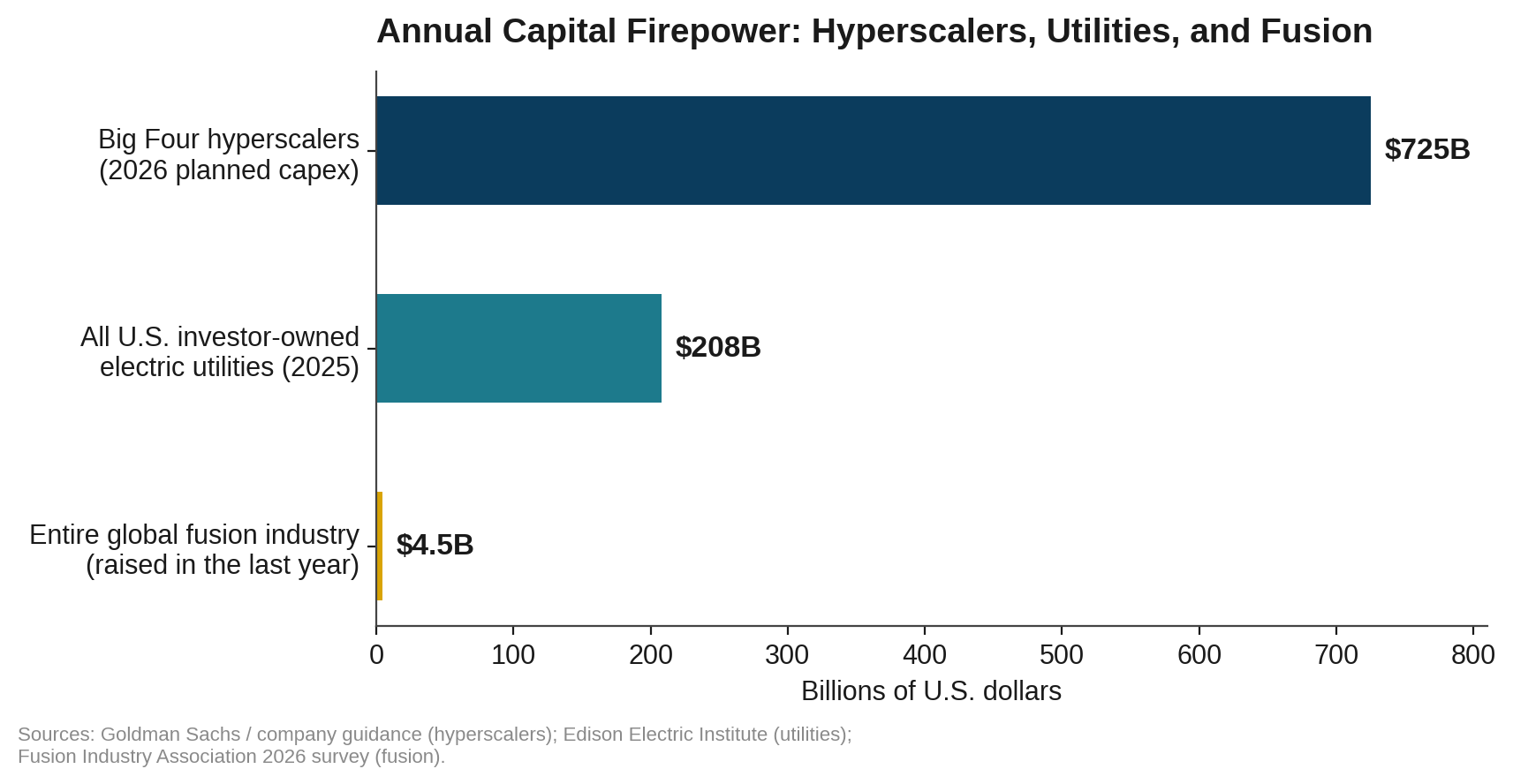
Figure 1. Annual capital spending: the Big Four hyperscalers, all U.S. investor-owned utilities, and the entire fusion industry.
Do the math: everything the entire fusion industry has ever raised equals just two percent of one year of Big Four capex. One percent exceeds every government fusion program on Earth, including China's. Willie Sutton would not need this explained twice.
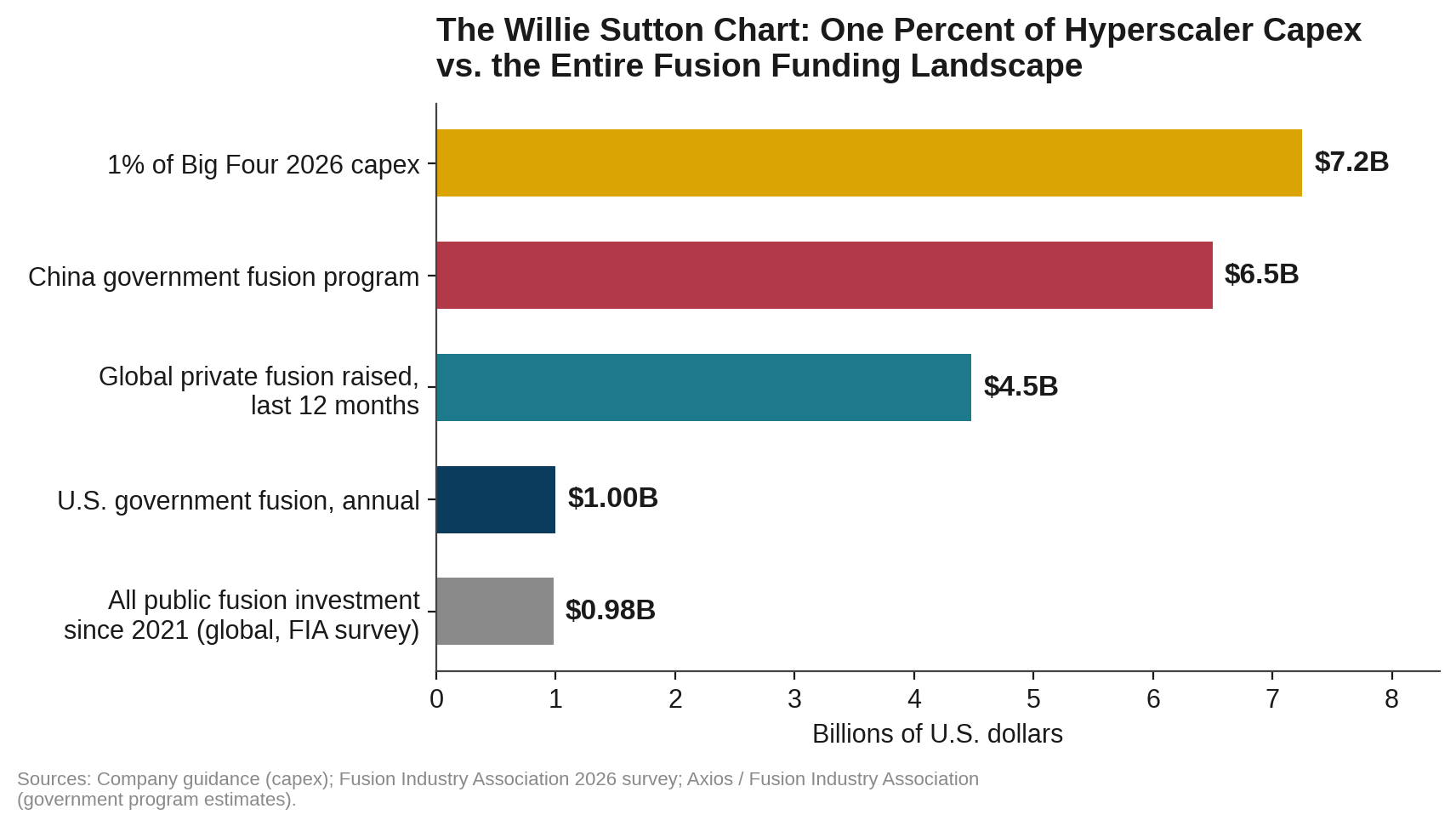
Figure 2. One percent of Big Four 2026 capex exceeds every fusion funding source on the planet.
Power Is Now an AI Architecture Problem
Money alone doesn't commercialize a technology. What makes hyperscalers different is that they combine the capital with the problem. Rack densities have climbed from 10 kW in the traditional enterprise era to 120-130 kW for modern AI racks, with roadmaps pointing toward 1 MW racks. AI campuses have jumped from hundreds of megawatts to multi-gigawatt scale, and U.S. data centers could consume nearly 12% of American electricity by 2030.
In September of 2026, we presented our analysis at Washington State Fusion Week, which suggests AI will require roughly 96 GW by 2030 while the grid can deliver about 72 GW on the required schedule: a 24 GW gap. Critically, the problem is not a shortage of energy resources. It is interconnection queues, transmission buildout, equipment shortages, and grid expansion timelines. An AI factory that can't get energized isn't an AI factory, and onsite generation is the solution.
There is a geopolitical layer as well. China is adding generating capacity and transmission at a pace the United States is not matching. GPUs only matter if they can be energized, which means power availability is becoming a national AI competitiveness question, and that urgency compresses timelines for everyone, including fusion.
The Money Is Already Moving
This is no longer a hypothesis. The hyperscalers have started writing checks, and the pattern is escalating from offtake to ownership. Microsoft signed the world's first fusion power purchase agreement with Helion in 2023, for at least 50 MW beginning in 2028, a contract that includes financial penalties for non-delivery. This is a real commercial commitment and not just a research grant. Helion broke ground on its Orion plant in Malaga, Washington, on land leased from the Chelan County Public Utility District, and has raised more than $1.5 billion at a $15.5 billion valuation with backing that includes OpenAI CEO Sam Altman as executive chairman, SoftBank, and steelmaker Nucor.
Google went further. In June 2025, it signed the largest direct corporate fusion purchase to date: 200 MW from Commonwealth Fusion Systems' first ARC plant in Chesterfield County, Virginia, alongside a second capital investment that CFS's CEO described as comparable to the $1.8 billion round of 2021, plus options on power from future plants. CFS then closed an $863 million round that brought in Nvidia, pushing its total raised to nearly $3 billion. Google has also backed TAE Technologies, and OpenAI has reportedly explored purchasing large quantities of fusion power for its own data centers. Investors, offtakers, and even the chipmaker at the center of the AI economy are now on fusion cap tables. The Sutton logic runs in both directions: fusion is going where the money is, and the money is coming to fusion.
Honesty requires acknowledging the schedule pressure. We discussed Helion’s delivery date, originally 2028, at Seattle Fusion Week in 2025, which is now widely reported as 2029, and the company has softened its Polaris milestone language from producing net electricity to demonstrating electricity from fusion. That slip matters, and skeptics are right to watch it. But it does not change the storyline. First-of-a-kind energy projects slip; what is new is that this one slips inside a commercial contract with penalties, a customer who needs the power, and a construction site with concrete in the ground. A one-year slip in a technology that was perpetually thirty years away is not a failure of the model. It is evidence the model has teeth.
Why Behind the Meter Wins the First Round
A fusion plant co-located with an AI campus, serving that load directly, steps around the very constraints that slow grid-connected generation. The developer answers to one customer with one balance sheet, not a docket. The comparison below is not a criticism of the utility path; it is a description of which race each model is built to run.
|
Deployment factor |
Behind the meter at an AI campus |
Traditional utility grid path |
|
Interconnection queue |
Largely bypassed; plant serves onsite load directly |
Multi-year regional queues, often 4 to 7 years before energization |
|
Transmission |
Minimal new direct transmission; generation sits next to the load |
Frequently requires new lines with decade-scale planning and permitting |
|
Regulatory process |
Bilateral commercial contract; standard siting and environmental review |
Rate cases, prudency reviews, and integrated resource plans before a public utility commission |
|
Customer |
One creditworthy counterparty with a signed offtake |
Millions of ratepayers served under regulated tariffs |
|
Who bears first-of-a-kind risk |
A corporate balance sheet built to absorb moonshot bets |
Ratepayers, whom regulators are rightly obligated to protect |
|
Value of a megawatt |
Priced against the compute margin it enables, far above retail power |
Priced against a regulated return of roughly 10% on approved capital |
|
Speed to first power |
Gated by technology readiness alone |
Gated by technology plus queues, rate cases, and transmission buildout |
|
Best suited for |
First-of-a-kind plants, where risk appetite decides |
Nth-of-a-kind deployment at scale, where cost of capital and operating discipline decide |
The Risk-Reward Asymmetry
The table’s most important row is who bears first-of-a-kind risk, because utilities and hyperscalers view that risk very differently.
A regulated utility must demonstrate to its commission that an investment is prudent, because the cost of a failed project can ultimately fall on ratepayers. That caution is not a flaw; it is part of how the system is designed to keep power reliable and costs in check.
A hyperscaler has a different calculation. The value of the computing capacity enabled by a megawatt of power can far exceed the value of the electricity itself. For a company investing hundreds of billions of dollars in AI infrastructure, taking on the risk of a first-of-a-kind power plant may be justified if it helps secure the enormous amount of firm power its data centers need. Same plant, very different risk equation.
Fusion’s output profile makes that connection even stronger. AI data centers need large amounts of power around the clock, and fusion is being developed to provide firm, continuous generation. Solar and wind remain important parts of the broader grid, but their output varies with weather and time of day. Fusion offers something particularly well suited to data centers: a potential new source of firm power that closely matches their 24/7 demand.
What Utilities Do Best, and When
None of this diminishes what governments and utilities have done or must still do. Public money built the scientific foundation: ignition at the National Ignition Facility happened on government funding, and DOE's milestone-based programs continue to de-risk the path to a pilot plant. And America's utilities are hardly standing still: investor-owned electric companies are investing nearly $208 billion this year, a record, with more than $1.1 trillion planned between 2025 and 2029 to expand and harden the grid. Utilities are already leaning into fusion where it makes sense, from Type One Energy's work with TVA to Dominion's territory hosting the ARC plant.
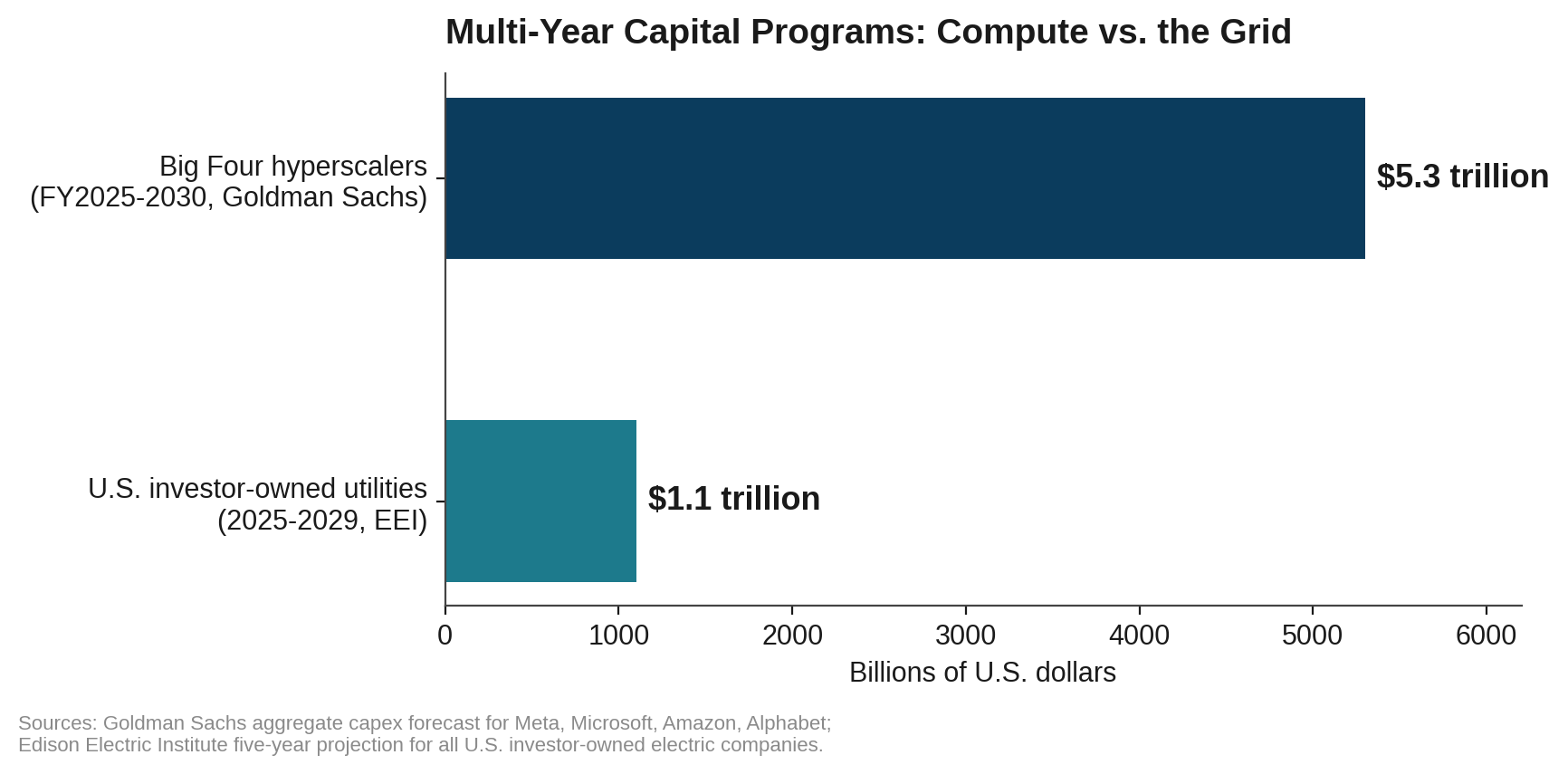
Figure 3. Both capital programs are enormous. The difference is what each can risk it on.
The distinction is structural, not cultural. Governments fund science; they do not buy power at scale. Utilities buy power at scale; they cannot underwrite unproven technology with ratepayer money, nor should they. Hyperscalers can do both, but only for as long as it takes to prove the technology. Once fusion is proven at the tenth plant instead of the first, the utility model becomes the superior one: rate-base financing at a low cost of capital, transmission and distribution expertise, decades of operating discipline with complex thermal and electrical machinery, and a mandate to serve everyone, not just the campus next door. The $1.1 trillion utilities are deploying this decade builds precisely the stronger grid that fusion's second act will need.
The Sequence
So the path looks like this. Fusion commercializes in the early 2030s, with Commonwealth's ARC in Virginia and Helion's Orion in Washington as the leading indicators. First deployments happen behind the meter or dedicated to AI campuses, funded by the only buyers with both the demand and the balance sheets to absorb first-of-a-kind risk. Improbably, hyperscalers become some of the world's largest energy producers. Then the technology comes to the rest of us, and that is precisely when utilities become indispensable. Behind the meter is fusion's on-ramp, not its destination. We project fusion could supply nearly 25% of U.S. AI data center power by 2040, and the utility-scale wave follows from there.
Sutton denied his famous line, but the fusion industry should not deny its own version of it. The money, the demand, and the urgency now sit in the same place for the first time in the technology's history. Go where the money is.