
High-Performance Food Packaging Films
Hit your barrier target with less resin, fewer discrete materials, and a structure the recycling stream will accept. Peak Nano re-architects the food-contact polymers you already run into precisely controlled nanolayer films, engineered around your spec, your line, and your qualified suppliers.
Barrier, Cost, and Recyclability Targets Are All Moving at Once
Packaging teams are being asked to solve for multiple priorities at once—often within the same film structure and on the same production line.
- Hold or extend shelf life. As distribution channels get longer, the packaging must work harder to extend shelf life.
- Lower cost. Once the line is optimized, the levers left are resin selection, tie layers, and gauge.
- Remove materials of concern. PFAS and other regulated chemistries are phased out on regulatory timelines, not R&D timelines.
- Design for recyclability. Store drop-off and monomaterial streams penalize the exact layers that deliver barrier.
Where a Conventional Structure Runs Out of Room
In a conventional coextruded film, each polymer behaves largely as it does in bulk. More barrier means more barrier resin and the tie layers it needs, so cost rises and recyclability drops. Less barrier resin simplifies the structure and the pack fails its shelf-life spec. Layer count is set by how many materials the structure requires, which leaves architecture off the table as a design variable.
Nanolayer coextrusion puts it back on. Layer count becomes something you set against a performance target rather than a consequence of your material list. That single change is what lets a film hold barrier, toughness, and recycle-readiness at the same time instead of trading one for another.
Why the Same Resin Delivers More Barrier at the Nanoscale
Below roughly 250 nanometers, a semi-crystalline polymer stops crystallizing the way it does in bulk. Instead of growing spherulites in three dimensions, it forms flat crystals oriented in the plane of the film. An oriented crystal is impermeable, so an oxygen or water molecule has to detour around every one of them. The path through the film gets longer, and the film measures higher barrier from the same amount of resin.
A second effect comes with the layer count. At nanoscale thickness, interfaces account for a large fraction of the structure, and polymer chains interpenetrate across every boundary while both melts are still hot in the die. Dissimilar polymers such as EVOH and polyethylene are able to layer together without an adhesive tie layer.
For a food package, these nanoscale effects extend beyond barrier performance. Layering rigid and flexible polymers can improve toughness and puncture resistance as the materials begin to behave as an integrated structure, while combining small amounts of specialty materials with commodity resins can unlock enhanced performance with less of the higher-cost material.
In practice, that creates multiple design opportunities: use less barrier resin to reach the same oxygen target, reduce or eliminate tie layers, improve toughness and puncture resistance, or downgauge without sacrificing shelf life. Which opportunity matters most depends on the performance and cost targets of the package.
A Platform With Qualified Product Already in the Market
The nanolayer platform rests on two decades of research at Case Western Reserve University with DARPA, the U.S. Naval Research Laboratory, and the Department of Energy, and on more than 20 patents. It is not just a laboratory result. NanoPlex™ LDF and NanoPlex HDC dielectric films ship today from Peak Nano's facility in Valley View, Ohio, characterized to ASTM D150, D149, D638, and JIS K7133.
They are produced on the same lines, by the same scientists, and on the same architecture principles a food packaging program would use. Capacitor customers do not tolerate variation across a web, which makes layer uniformity a production discipline here rather than an aspiration. That matters for barrier more than for almost anything else, because barrier only holds if every layer holds. Food packaging is a new application for a platform that is already qualified elsewhere.
Four Food Packaging Problems We Take On
Most programs arrive as one of these four, and several arrive as two at once. Every one of them starts from polymers your organization already understands, qualifies, and sources.
Barrier Beyond EVOH
Reduce EVOH content, replace it, or extend shelf life at the same content. We split the barrier resin across many confined sub-micron layers so each one crystallizes in the oriented, low-permeability form, then protect it with moisture-resistant polyolefin. Success is measured against your own OTR and MVTR spec, at your gauge and your test humidity.
Cost Reduction
Remove tie layers, cut the share of the most expensive resin, and downgauge the structure. Adhesive layers stop being necessary once the interfaces carry the bond, and functional layer count can come down even as total layer count goes up.
Materials of Concern
Design out PFAS and other regulated chemistries without giving up function. Because the performance comes from geometry, an already-cleared polymer can often recover a function that a coating or additive used to supply.
Flex and Puncture
Combine tough and flexible materials in one structure instead of choosing between them. A single thick barrier layer can crack under folding and flexing, which destroys the barrier it was there to provide. Many thin layers stay intact through handling, while dedicated tough layers carry puncture resistance.
Bring us the food packaging challenge you have not been able to solve.
What We Could Actually Change
A Peak Nano program works on the structure, not the chemistry. These are the levers and what we would measure to prove each one.
| Design Lever | Conventional Structure | What We Would Explore | How It Gets Proven |
|---|---|---|---|
| Barrier Resin Placement | One thick EVOH core layer | EVOH partitioned across many confined layers | OTR at your spec gauge and humidity |
| Interlayer Adhesion | Tie layers between dissimilar polymers | Interfacial adhesion, tie layers reduced or removed | Bond strength and delamination after flex cycling |
| Layer Count | Set by the number of materials required | Set by the property being targeted | Functional layer count at equal or better performance |
| Gauge | Set by the most demanding single requirement | Downgauge on barrier per micron | OTR, MVTR, puncture, and seal integrity at reduced gauge |
| Recycle-Readiness | Multi-material laminate with adhesives | Polyethylene-dominant, recycle-ready structure | Barrier resin content against the recycling guidance for your market |
| Line Behavior | Fixed by the incumbent structure | Seal window, optics, and metallization held as constraints | Trials on your converting and filling conditions |
Formats and Food Categories We Support

Snack Food & Dry Goods
Moisture and oxygen protection against staleness and lipid oxidation, high puncture resistance for VFFS, and reliable seal performance at line speed.
Fresh Produce, Meat & Perishables
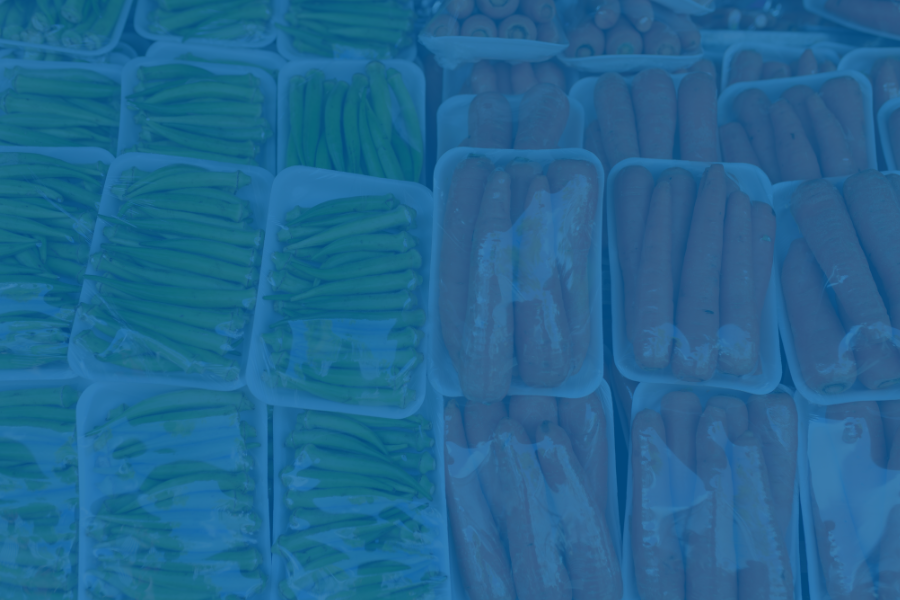
Vacuum skin packaging and lidding films featuring optical clarity in refrigerated displays, tuned permeability, and puncture resistance designed to handle bone-in cuts.

Coffee, Pet Food & Specialty Formats
Valve-compatible structures, heavy-duty puncture resistance, and extended shelf-life targets.
What Packaging Engineers Ask Us First
1. Will Peak Nano's technology run on my existing film production line and with existing equipment?
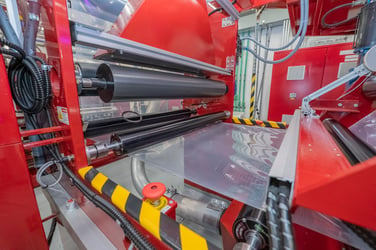
Nanolayer films are made with standard cast and blown coextrusion equipment. The layer multipliers sit in the tooling, not in a different class of machine. We work with your team to evaluate film behavior early in the program and treat them as constraints rather than as variables to be discovered at scale-up.
2. Do I need to requalify my materials for food-contact compliance?
Architectures are built from polymers already cleared for food contact and already in your qualified supply base, so the work starts from an existing clearance position rather than from zero. While every new structure requires qualification, starting with established materials can shorten the path compared with introducing a new resin. Compliance is verified for each structure and application.
3. Can I keep my existing resin supplier, or do I need to switch resin suppliers?
No. If an extrudable polymer is in your qualified supply base, it is a candidate.
4. How quickly can I get a physical sample or prototype?
First coextruded samples arrive in weeks after agreeing on the research scope and receiving materials. A validated, scalable structure takes months, not the years a new resin would require.
5. What deliverables and physical outputs do I receive?
A validated film architecture with layer count, layer order, materials, and thickness tested against the metrics you set at intake. A scale-up pathway with process conditions proven from R&D through pilot. And a data package that supports your own qualification work.
6. Who owns the intellectual property created during the engagement?
Ownership and commercialization rights are defined in the project agreement before development starts, so freedom to operate is settled ahead of scale-up rather than negotiated after it.
7. Who manufactures the finished film?
Peak Nano tolls it, you run it on your own coextrusion lines, or a pre-qualified partner produces it. The choice is made after the architecture is validated, not before.
How a Peak Nano Films as a Service Program Runs
(approximately 3 to 6 months) Metrics and materials formulation, proof-of-concept coextrusion and testing, then review against your metrics.
(approximately 3 to 6 months) Process optimization and scale-up, then a second review against your metrics.
(approximately 3 months)
Prototype samples and pilot production on Peak-owned lines in Ohio.
Ready to see if this fits your application? Book a technical scoping call.
Why Packaging Teams Work With Peak Nano
- Senior R&D Bench: Direct access to PhD polymer scientists specializing in extrusion, rheology, and barrier film design.
- Two Decades of Provenance: Technology originating from research with Case Western Reserve and backed by DARPA and the U.S. Naval Research Lab.
- Integrated Scale: Feasibility work, prototype rolls, standalone pilot lines for scale-up, and mid-tier runs on Peak-owned lines in Ohio, shortening the loop between concept and testing.
- Commercial Maturity: Peak’s nanolayer platforms are already qualified in high-tolerance dielectric markets. Food packaging represents a new application for a proven platform.
- Rapid Development: Deliver first-generation nanolayer prototypes in six to 10 weeks from design approval.
- Staged, Low-Risk Engagement: Enter at research, development, scaling, or commercialization phases. Transfer architectures to your lines or utilize qualified manufacturing partners.
The Expertise Behind Our Food Packaging Films
.png?width=200&height=200&name=Dr.%20Ponting%20(1).png "Dr. Ponting (1)")
Dr. Michael Ponting
Chief Scientific Officer
Inventor of NanoPlex technology and co-author of the reference text on multilayer polymer films.
.png?width=200&height=200&name=Pam%20Wilson%20(2).png "Pam Wilson (2)")
Dr. Pam Wilson
Director, Global Applications Engineering
Leads customer programs from intake metrics through validated architecture and scale-up.

Dr. Zahidul Wahab
Research Fellow, Polymer R&D and Innovation
Leads research and innovation in biodegradable films.
Frequently Asked Questions
Conventional coextrusion stacks thick layers and bonds dissimilar materials with tie layers, performing roughly like the average of its parts. Nanolayering makes layers ultrathin so their interfaces dominate, allowing polymers to bond without tie layers and forcing confined EVOH to form more efficient barrier crystals.
The goal is to optimize and reduce secondary materials, which gets us closer to an ideal recycle-ready monomaterial. Confining EVOH into nanolayers hits oxygen targets with less material and cuts tie layers. How far the content can come down is specific to the structure, the gauge, and the shelf-life spec, and it is established by trial rather than predicted. Keeping EVOH at or below 5% of a PE film structure aligns with leading design-for-recycling guidance, subject to the tie layers and overall structure. Source
The design target is a recycle-ready structure: reduce the barrier resin content and remove the adhesive tie layers so the film moves toward a polyethylene-dominant design that recycling streams accept. Recyclability is determined by the stream and the guidance that applies to it, so it is assessed per structure against the relevant regional criteria rather than claimed generically.
In some structures, yes. Because the performance comes from how the layers are arranged rather than from an added chemistry, a function previously delivered by a fluorinated material can sometimes be recovered geometrically using polymers already cleared for food contact. Feasibility depends on which property the coating was providing.
Yes. Seal integrity, puncture resistance, and mechanical toughness at line speed are treated as intake requirements, and structures are trialed against your converting and filling conditions before scale-up.
A single thick EVOH layer can crack under folding and flexing, destroying barrier properties. Multiple sub-micron layers stay intact through handling, while dedicated tough polymer layers maintain overall puncture resistance.
Yes. Nanolayer architectures use commercial polymers already approved for food contact, allowing customers to work within existing FDA clearances. Compliance is verified per structure and application.
FaaS is Peak's contract research program. You bring materials and requirements; our scientists design and test nanolayer architectures. Because we develop solutions using existing commercial resins, Prototypes arrive in 6 to 10 weeks, structured in stages from feasibility to scale-up.
Nanolayer films utilize standard industry coextrusion processing. Our specialized multipliers enable optimized structures that often require fewer layers, which often means fewer active extruders on your line.
Request a Discovery Call
Explore how Peak Nano’s Films as a Service (FaaS) nanolayering platform can accelerate your next custom polymer film development program.
Discuss your application, performance requirements, prototype goals, and path to manufacturing with the Peak Nano team.
Resources
Doing More With Less EVOH: How to Unlock More From Existing Polymers in Food Packaging
NanoPlex™ Films as a Service (FaaS)