
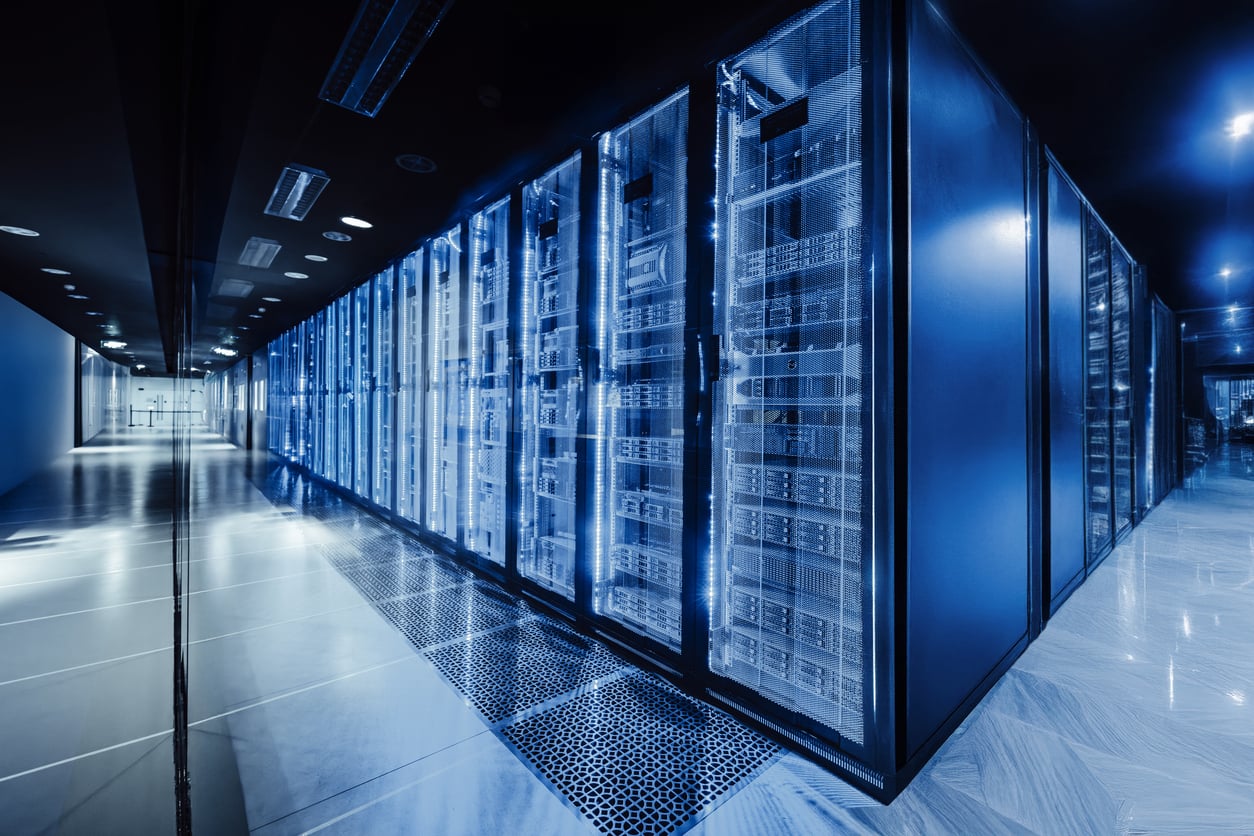


Today, nearly everyone has heard of data centers, but few people know much about their origins. Interestingly, data centers have been around nearly as long as computing, with one of the first mainframe computers, the Electronic Numerical Integrator And Computer (ENIAC; completed in December, 1945), being housed in one of the original data centers. 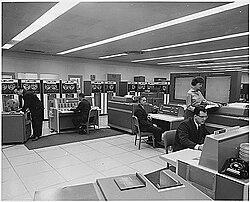
These mainframes required large amounts of power and cooling to operate, which was one of the reasons data centers were used to house them. These data centers pioneered the concept of raised floors, standardized racks to secure the computer equipment, and trays mounted overhead above the racks to hold the data communications cables. In the late 1990s, data centers evolved to include today’s rack-housed Intel/AMD X86-based servers, with power needs of 1KW-2KW per rack, increasing up to 10KW per rack today.
The Use of GPUs For Supercomputers and Artificial Intelligence (AI) Servers
In the early 2010s, Graphics Processing Units (GPUs) were incorporated into scientific computing. In these architectures, the hundreds of numerical processors (“cores”) embedded within graphics cards were initially used to perform parallel processing for scientific computing.
The advantage of GPU computing was that relatively low-power graphics cards could be used to provide extremely high numerical computing performance. Oak Ridge National Laboratory's Titan, built by Cray and outfitted with NVIDIA Tesla K20X GPUs, was one of the first supercomputers to harness GPUs at scale, briefly claiming the title of world's fastest supercomputer in 2012. Initially, non-supercomputer GPGPU (general-purpose computing on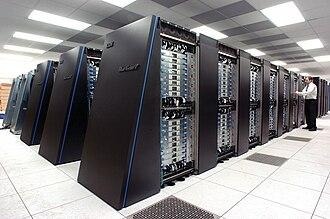 graphics processing units) computing was performed utilizing standard Intel-based servers with extra card slots that would be filled with standard graphics GPUs such as NVIDIA Tesla graphics cards
How Power Density Escalated from Titan to the DGX H200
Today, a single NVIDIA H200 GPU card contains 16,896 CUDA cores, 528 tensor cores, and 141 GB of HBM3e memory. An NVIDIA DGX H200 server, which contains eight H200 GPUs in an 8U form factor, has more capability than an entire 96-rack IBM BlueGene/Q supercomputer from 2006 (32 PFLOPS for the DGX H200, vs roughly 20 PFLOPS for the BlueGene/Q). However, larger single-rack servers—using between 32 to 80 NVIDIA H200 cards—can consume between 40KW-100 kW each, as much as an entire row of servers consumed 15 years ago (10-30 racks generally are in a row of servers).
At 40kW to 100kW per rack, power architectures are critical in today’s AI data centers. Beyond just the power being consumed, AI clusters impose unusually large, variable, and concentrated electrical loads. A modern design must move utility-scale power through substations, medium-voltage distribution, transformers, switchgear, uninterruptible power supplies, busways, and rack-level conversion stages while maintaining voltage quality and redundancy.
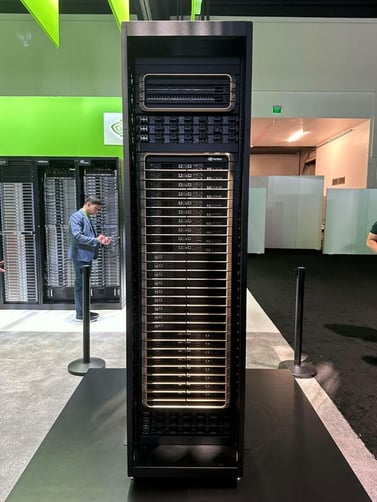
The architecture must also accommodate high-density racks, rapid changes in accelerator utilization, and the growing shift toward direct liquid cooling; its pumps and heat-rejection systems add to facility demand. A poorly matched architecture can create bottlenecks well before the computing hardware reaches its intended capacity.
How Big is the AI Power Issue for Data Centers?
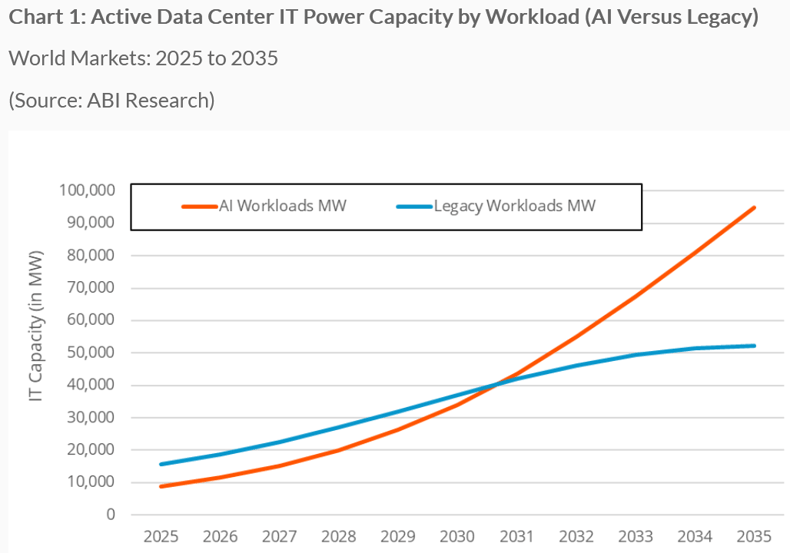
To be sure, servers for AI are largely the only ones pushing the limits of data center power architectures. Standard enterprise racks draw 5KW-10KW per rack today, utilizing 1U or 2U rackmount servers. Even high-density CPU or HPC clusters max out around 20 kW to 30 kW per rack, despite being tightly packed with multi-socket blade servers or heavy database nodes. While AI is a small part of the total IT workload (as measured in megawatts) today, it is expected that AI workloads will exceed legacy workloads by 2031, and by 2035 it will be almost two-thirds of the overall IT workload.
Why Voltage Matters in a High-Density Rack Power Architecture
System power architects must coordinate higher-voltage distribution, rack-level protection and monitoring, backup power, and liquid-cooling capacity as one integrated design—because nearly all electrical power ultimately becomes heat that must be removed reliably. An 800 VDC architecture is attractive for very high-density AI racks because it delivers the same power with much lower current and can eliminate several AC-to-DC/DC-to-DC conversion stages.
|
Attribute |
800 VDC architecture |
Conventional AC rack architecture |
|
Cooling burden |
Less conversion loss means less heat generated by electrical equipment, reducing associated cooling demand |
More conversion losses add to the heat that facility cooling systems must reject |
|
Rack space use |
A direct high-voltage DC path can reduce the size and number of rack power shelves; NVIDIA says its late-stage conversion approach can occupy 26% less area than traditional multistage designs |
More rack-level power-supply and conversion equipment competes with compute hardware for valuable rack volume |
|
Scaling |
Better suited to racks approaching megawatt-scale power because current, conductor mass, and distribution losses remain more manageable |
Traditional distribution becomes physically and economically harder to scale at ultra-high rack densities |
|
Reliability potential |
Fewer conversion devices can mean fewer components that generate heat or can fail |
More conversion stages create more components and potential failure points |
In comparison, conventional AC power distribution systems mean more electrical losses and waste heat in the rack as AC power is converted to final DC voltage; moreover, copper conductors and connectors in a 100kW AC rack can weigh up to 200 lbs., a burden that only grows as racks scale to 200 kW-to-megawatt-class systems. However, the switch to DC rack power architectures does require purpose-built high-voltage DC protection, switching, and connectors.
At a fixed power level, current follows I=P/V. Raising distribution voltage from 415 VAC to 800 VDC therefore substantially lowers current, which reduces I2R resistive
losses and permits smaller conductors or more power through the same copper. That is especially consequential for an AI rack filled with accelerators operating simultaneously: the electrical system must deliver very large, steady loads without turning distribution cables and conversion equipment into a space, cost, or thermal bottleneck.
With that said, 800 VDC is not a drop-in replacement for all existing AC infrastructure. AC remains the grid standard and is mature for protection, switching, and maintenance. The shift to high-voltage DC moves complexity into specialized rectification, isolation, fault detection, arc interruption, and rack-level conversion equipment. The value proposition is consequently strongest in purpose-built or substantially redesigned AI facilities with sustained, exceptionally high rack power—not necessarily in lower-density, general-purpose data centers.
Conclusion: 800 VDC Power For AI Computing Makes Sense
AI data centers represent a new level of power usage and server requirements in cloud computing. Consolidation of thousands of high-thermal design power (TDP) GPUs requires localized power and cooling intensity that traditional air-cooled, low-voltage footprints cannot sustain.
Additionally, lower distribution voltages (like legacy 12V or 48V/54V systems) suffer from severe I²R resistive losses and massive copper weight constraints at high amperage. Moving to an 800 VDC power architecture drastically cuts current requirements and ohmic losses, allowing efficient power delivery over thinner conductors and moving heat-producing AC-DC power conversion systems out of the compute rack and to the edge of the data center.
In our next blog in this series, we will look into what it takes to successfully implement an 800 VDC architecture. We will discuss different approaches to a DC-powered data center, including the advantages and disadvantages of each. We'll finish up with the leading design for DC data centers being championed by NVIDIA. The creator's blog will look at the key systems in the DC data center and what the requirements are for those key systems.