
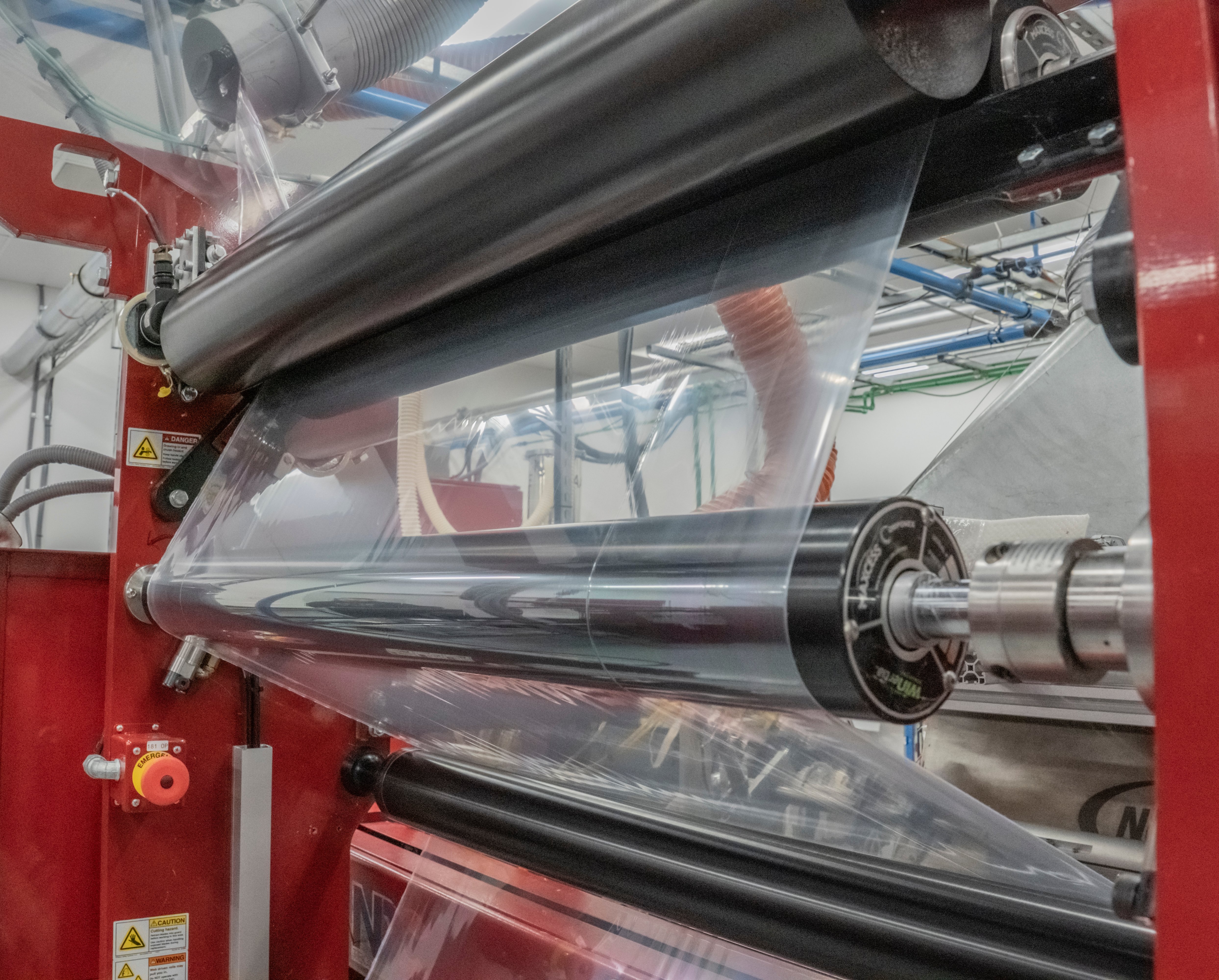


A packaging engineer has a barrier target the current structure barely meets, a brand owner asking for recycle-ready packaging, and a resin list that cannot change without months of requalification. Adding more barrier material, whether EVOH, nylon, or PVDC, often means additional tie layers and a more complex structure that can be harder to recycle. Waiting for a new resin can mean waiting years.
Conventional multilayer films are ultimately constrained by the properties of their materials. Nanolayering takes a different approach: changing the architecture instead of the chemistry. Below roughly 250 nanometers, confinement can change how polymers crystallize and interact, creating properties that aren’t achievable through conventional layering alone.
That approach has implications well beyond packaging. The energy grid, fusion, and electric vehicles need dielectric films for capacitors that can withstand temperatures conventional materials like biaxially oriented polypropylene (BOPP) were not designed to handle. Medical packaging engineers need films that maintain critical properties through sterilization.
In our recent technical whitepaper, Engineering New Film Capabilities Through Nanolayer Architecture, Peak Nano explores the science behind nanolayering, the research supporting it, and where the technology stands commercially. This post highlights the key takeaways.
Key takeaways
-
Nanolayering through multipliers creates 32 to more than 4,000 alternating polymer layers, each as thin as 25 nanometers.
-
Below about 250 nanometers, confinement creates emergent barrier, dielectric, thermal, and mechanical properties.
-
It runs on standard resins and coextrusion lines; the added tooling typically costs 5 to 10% of the extrusion system.
-
Nanolayer adhesion frequently eliminates tie layers, supporting recycle-ready design.
Why Conventional Multilayer Films Hit a Ceiling
Traditional multilayer films use 3 to 11 layers, each tens of microns thick, and follow the rule of mixtures: each layer contributes its known properties, and total performance is the sum of the parts. New performance levels require new polymer chemistry, dissimilar polymers need tie layers, and no structure can outperform its materials at their relative amounts. Blending does not escape the ceiling either, because immiscible blends disperse randomly and give up control over geometry and interfaces.
[Image placement: Whitepaper Figure 1, Traditional Multilayer vs. Nanolayered Film Architecture. Alt text: Comparison of a five-layer film with tie layers and a nanolayered film with thousands of alternating A/B layers.]
What Is Nanolayering?
Nanolayering is a coextrusion process that builds a polymer film from dozens to thousands of alternating layers, each as thin as 25 nanometers, to create properties neither polymer delivers on its own.
Nature has used this principle for hundreds of millions of years. Nacre, or mother-of-pearl, alternates brittle aragonite with a soft biopolymer and reaches fracture toughness approximately 3,000 times greater than monolithic aragonite.
Below approximately 250 nanometers, adjacent layers constrain how polymer chains organize and crystallize, and interphase effects at each boundary begin to dominate. The result is qualitatively new behavior, documented across more than 40 years of research that originated largely at Case Western Reserve University, was commercialized by Peak Nano, and is compiled in Langhe and Ponting's reference text (2016).
How Layer Multiplication Works
Peak Nano's nanolayer coextrusion process uses sequential layer multiplication, also called split and stack. Polymer melts from conventional extruders enter a feed block that forms an initial layered stream, then pass through multiplication dies that each split, stack, and recombine the flow to double the layer count. With n multipliers, the film contains 2(n+1) layers, so 10 multipliers yield 2,048 layers.
Layer count and thickness are set by the multipliers and feed ratios, independent of total film thickness. Everything else on the line (extruders, melt pumps, dies, chill rolls, winders) is standard, which makes this precision nanolayer architecture practical from development through pilot production. The process is protected by Peak Nano's patent portfolio and works across most commercial thermoplastics, from polyolefins, nylons, and PET to fluoropolymers, bio-sourced polymers, and recycled streams.
[Image placement: Whitepaper Figure 2, Layer Multiplication Process. Alt text: Two extruders feeding a feed block and sequential multiplier dies that double layers from 2 to 2,048.]
What Happens Below 250 Nanometers
Semi-crystalline polymers normally cool into random, three-dimensional spherulites. Polymer confinement changes that: in a sub-micron layer thin enough to approach crystal dimensions, spherulitic growth is suppressed and the polymer forms lamellae oriented parallel to the film surface. Biaxial orientation, the same stretching used to make BOPP and BOPET, can further activate the effect.
Those oriented crystals force gas molecules along a longer, more tortuous path. Research published in Science (2009) showed PEO confined to about 20 nanometers cut gas permeability by two orders of magnitude, and a 2010 study in Polymer achieved an order-of-magnitude oxygen barrier gain in biaxially oriented polypropylene without sacrificing clarity or toughness.
[Image placement: Whitepaper Figure 3, Confinement-Induced Crystallization. Alt text: Crystal morphology changing from spherulites at 20 µm to stacked lamellae at 25 nm, with a tortuous oxygen path.]
The Properties Nanolayering Unlocks
Barrier
Confined crystals can reduce oxygen permeability by up to 100 times compared with polyethylene, supporting use of current materials for higher barrier or a significant reduction in the specialty barrier resin used within a structure.
Dielectric and Thermal Performance
Interfacial barrier effects raise breakdown strength and energy density, while oriented crystals improve heat capability and reduce shrinkage, enabling polypropylene-based dielectric films to operate reliably 30°C above standard BOPP.
Mechanical Toughness
Nanolayering gives designers a new lever on the toughness-stiffness balance: normally brittle polymers become tough and ductile, shifting from brittle fracture to energy absorption, as Peak Nano researchers reported in 2026.
Adhesion Without Tie Layers
At nanoscale thickness, the physics of interlayer adhesion change. Cumulative bonding across thousands of interfaces, plus mechanical interlocking as confined layers crystallize, frequently eliminates tie layers in multilayered structures, reducing extruders, material cost, and recycling complexity.
Performance Without a Cost Penalty
Retrofitting an existing line requires only a feed block and multiplication dies, typically 5 to 10% of the extrusion system cost as a one-time expense. The passive dies have no moving parts, operating cost per kilogram is essentially unchanged, and raw material cost stays the same or falls because no specialty resins are needed and tie-layer resins can often be removed.
Where Nanolayering Is Applied Today
Energy storage. Peak NanoPlex™ LDF capacitor film is deployed across defense, grid, transportation, and fusion energy. It operates at 135°C (vs. 105°C for BOPP-C) with lower losses, higher breakdown strength, and reduced shrinkage, as a drop-in upgrade for BOPP-C. NanoPlex HDC serves energy-dense designs in power grids, electric vehicles, and fusion systems.
Food and medical packaging. Peak Nano's food packaging work focuses on replacing materials of concern as regulations tighten, including EU PPWR PFAS restrictions that took effect in August 2026. Building new architecture from already-approved polymers avoids lengthy requalification, and the near-term payoff is film downgauging and recycle-ready, sustainable packaging films. Separately, a research program started in early 2026 is exploring PLLA, PCL, and PVOH for water and oxygen barrier in degradable films, with initial results expected later this year. Medical packaging programs target sterilization-resistant toughness, heat capability, and replacement of fluorinated resins.
Areas in development. The platform also opens chemical-resistant packaging for aggressive solvent, acid, and base environments, antimicrobial films, ultra-low migration barriers, and all-polymer lamination films as an alternative to foil.
Developing a Film With Peak Nano Films as a Service
Peak Nano Films as a Service (FaaS) is a collaborative development program, not a catalog of fixed grades. Customers bring performance targets, existing resins, and line constraints; Peak Nano designs the nanostructure and runs prototypes on R&D and pilot lines at its Ohio facilities. First-generation prototypes typically arrive 6 to 10 weeks from design approval, and programs conclude with a full technical transfer package.
Have a film performance target your current structure can't reach?
Bring your targets, resins, and line constraints. Start a Peak Nano Films as a Service project.
Frequently Asked Questions
-
Why do nanolayered films exceed the rule of mixtures?
In conventional multilayer films, each layer adds its known properties, so the film performs as the sum of its parts. Below about 250 nanometers, confinement changes the crystal structure, chain orientation, and interphase behavior of each layer. The result is new behavior that comes from the architecture itself, not a better version of the bulk material. That is why barrier, mechanical, thermal, and electrical properties can exceed what the same polymers deliver in a conventional structure.
- How are layer count and film thickness controlled?
Layer count follows a simple formula: with n multiplying elements, a film has 2^(n+1) layers, so 10 multipliers yield 2,048 layers. Layer count and individual layer thickness are set by the number of multipliers and the feed ratios of the polymers. Total film thickness is set separately by die gap, draw ratio, and optional biaxial stretch ratios. This lets engineers tune the nanostructure without changing the final gauge. - What does a nanolayer retrofit cost, and does it change operating cost?
Adding a feed block and multiplier dies typically costs 5 to 10% of the overall extrusion system cost. It is a one-time capital expense, not an increase in product cost. The dies are passive, with no moving parts, and need only simple heating and add negligible pressure drop. Energy use, labor, maintenance, and scrap rates stay comparable to conventional multilayer production. - Does biaxial orientation improve nanolayered film performance?
Yes. Biaxial orientation, the same machine- and transverse-direction stretching used to make BOPP and BOPET, can further activate the property gains that nanolayering creates. The confined layers crystallize differently during and after stretching. Wide-angle X-ray scattering (2D-WAXS) has confirmed further crystal alignment in oriented PCL and PEO nanolayers, producing structures that conventional film processing cannot create. -
How do nanolayers reduce oxygen permeability?
Confined crystals form oriented layers that force gas molecules to travel mainly around crystalline domains or through small disordered gaps. This much longer path can reduce oxygen permeability by up to 100 times compared with polyethylene. Changing layer thickness controls the amount of crystallinity and the size and spacing of those gaps. This is also why barrier resins such as EVOH can be used in lower volume fractions.
- Which polymer combinations bond without tie layers?
Peak Nano has demonstrated tie-layer-free bonding in four types of polymer combinations: polyolefin/engineering polymer; fluoropolymer/hydrocarbon; primary/recycled; biodegradable/conventional. In each case, confinement alone provides enough adhesion, without chemically modifying either polymer. Removing tie layers reduces the number of extruders a structure needs and removes tie-layer resins from the bill of materials. - Can nanolayering toughen brittle polymers?
Yes. When normally brittle polymers are structured as nanolayers with a flexible polymer, their elongation and toughness improve dramatically, and failure shifts from brittle fracture to ductile energy absorption. For medical packaging, this toughness holds after sterilization exposure, which matters for films that must survive autoclave, gamma, e-beam, or EtO processing. - What temperature advantage do nanolayered dielectric films offer over BOPP?
Confinement-induced crystal orientation raises heat capability and reduces shrinkage. This lets polypropylene-based dielectric films operate reliably 30°C above standard BOPP. NanoPlex™ LDF capacitor film operates at 135°C versus 105°C for BOPP-C, with lower dielectric losses at temperature and dramatically reduced shrinkage, as a drop-in upgrade for BOPP-C applications.
Sources
- Langhe, D. S., & Ponting, M. T. (2016). Manufacturing and Novel Applications of Multilayer Polymer Films. William Andrew (Elsevier). https://shop.elsevier.com/books/manufacturing-and-novel-applications-of-multilayer-polymer-films/langhe/978-0-323-37125-4
- Carr, J. M., Langhe, D. S., Ponting, M. T., Hiltner, A., & Baer, E. (2012). Confined crystallization in polymer nanolayered films: A review. Journal of Materials Research, 27(10), 1326–1350. https://link.springer.com/article/10.1557/jmr.2012.17
- Wang, H., Keum, J. K., Hiltner, A., Baer, E., Freeman, B., Rozanski, A., & Galeski, A. (2009). Confined crystallization of polyethylene oxide in nanolayer assemblies. Science, 323(5915), 757–760. https://www.science.org/doi/10.1126/science.1164601
- Lin, Y., Hiltner, A., & Baer, E. (2010). Nanolayer enhancement of biaxially oriented polypropylene film for increased gas barrier. Polymer, 51(24), 5807–5814. https://doi.org/10.1016/j.polymer.2010.09.070
- Wahab, Z., Hughes, K., Landry, J., & Ponting, M. (2026). Nanolayer coextrusion of amorphous and semi-crystalline polymers for enhanced thermal and mechanical properties. Journal of Plastic Film & Sheeting, 42(3), 310–325. https://doi.org/10.1177/87560879261457364
- Peak Nano. (2026). Engineering New Film Capabilities Through Nanolayer Architecture [Whitepaper]. [Replace with whitepaper landing page URL]
- Peak Nano. Nanolayer Coextrusion Technology. https://www.peaknano.com/nanolayer-coextrusion
- Peak Nano. NanoPlex™ LDF Capacitor Films. https://www.peaknano.com/nanoplex/ldf
- Peak Nano. Peak Nano Films as a Service. https://www.peaknano.com/films-as-a-service